
The Spirit and the Servant
-
 January 7, 2026
Baptism of the Lord - Isaiah 42:1-4, 6-7
Thus says the LORD:
I, the LORD, have called you for the victory of justice,
Here is my servant whom I uphold,
my chosen one with whom I am pleased,
upon whom I have put my spirit;
he shall bring forth justice to the nations,
not crying out, not shouting,
not making his voice heard in the street.
a bruised reed he shall not break,
and a smoldering wick he shall not quench,
until he establishes justice on the earth;
the coastlands will wait for his teaching.
I have grasped you by the hand;
I formed you, and set you
as a covenant of the people,
a light for the nations,
to open the eyes of the blind,
to bring out prisoners from confinement,
and from the dungeon, those who live in darkness.Our first reading contains the first of Isaiah’s famous Servants Songs found in Isaiah 42:1-4, 49:1-6, 50:4-9, and 52:13-53:12. These songs are about, and at times in the voice of the mysterious figure whom Isaiah calls simply “the Servant of the Lord.” The Servant is the embodiment of faithful Israel, and as such he has a mission to gather those who have been scattered, to bring people back into covenant relationship with their Creator. In later Servant Songs, Isaiah will reveal that the Servant will also suffer for the sins of the people (see Isaiah 53:4).
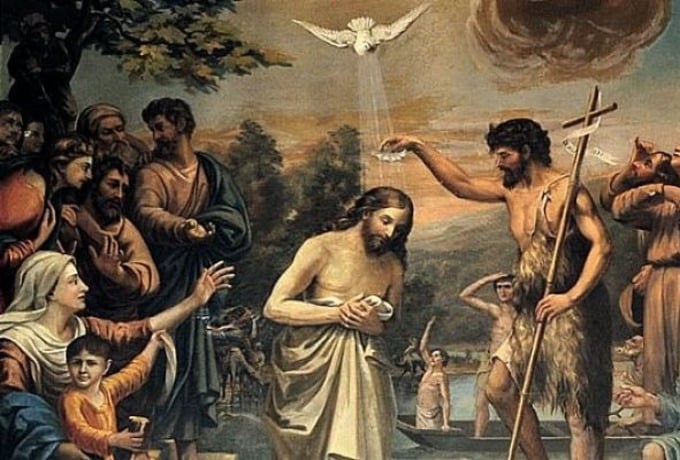
The Lord’s message through Isaiah has clear echoes in the baptism and ministry of Jesus recorded in the Gospels. The voice from the heavens at Jesus’ baptism quotes this passage nearly verbatim: “my chosen one with whom I am pleased.” The Lord also points out that this servant figure is the one “upon whom I have put my spirit,” and the Gospels recall that at Jesus’ baptism this happened “in bodily form like a dove” (Luke 3:22). The final line of Isaiah’s message for this week speaks to Jesus’ ministry of forgiving sins and healing blindness. All of this prophesied some six centuries prior.
There is a significant change in wording when the Lord echoes what he has already said through Isaiah at Jesus’ baptism. Through Isaiah, he refers to his servant, and at the baptism he refers to his beloved Son. Of course the wording of sonship has to do with Jesus’ core identity as the Second Person of the Trinity, but it also has to do with us as little christs. To serve the Lord is to become his beloved daughter or son, his close family. We typically see sonship and servitude as very different things, but the first Christians did not. St. Paul often bragged about being the slave of the Lord (see Titus 1:1 among many others). Mary referred to herself as the “handmaid of the Lord” (Luke 1:38). And you and I are both servants of God and children of God (see 1 John 3:1).
All of this is by the grace of our own baptism, which receives its power from the One who entered the waters of baptism along the banks of the Jordan River.